November 24, 2009
Geotag Icon (map) Matera, Basilicata

matera1 MateraImagine visiting an authentic Italian town so steeped in the architecture of thousands of years ago that you are able to wander around without seeing any vestige of modern times.

Located in the Basilicata region of southeastern Italy, Matera’s beginnings in the Neolithic age are still visible as caves carved out of a rocky ravine. Homes were carved out one above the other in what appears to be a haphazard fashion; a road becomes a stairway…becomes a roof…becomes a garden. These caves are suspected to be some of the first human settlements in Italy.

matera2 MateraWe’re fairly hopscotching the side of the hilly sassi (stones) district, imagining we’ve been transported back to the time of Christ; no wonder Mel Gibson used the town as the setting for his Passion movie. When asked what our favorite Italian town is, this is certainly it.

Over many centuries, the town has dealt with progress as well as abandonment; rapid increases in population resulted in the inability to provide water to the old residential center, effectively drying the life out it, and turning it into a ghost town for decades.

In the 1950’s, the Italian government deemed that it would be impossible for inhabitants to continue to live here, so offered them new houses in return for abandoning their ancient ones.
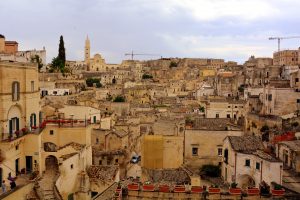
matera3 MateraFor about 15 years, more than 18,000 people abandoned their old properties in order to move to new outlying districts, and the evacuation of the historical center took place. Matera was now a lively city with a completely dead center.

The ancient city of Matera became one the greatest completely abandoned historical centers in the world. Thanks to UNESCO and the European Union, life has returned to the town, but not without its critics.

Today, ancient caves have been restored and inhabited; there are many thriving businesses, pubs, and hotels. But local environmental associations are fighting to preserve Matera from the invasion of mass tourism, which they believe would violate the sacred space and magical atmosphere of the place.

matera4 Matera

Bookmark and Share


-- Written by Evanne Brandon Diner (see bio), chronicler of local village life in Northern Lazio, and central Italy property restoration and purchasing consultant (www.lavventuraitalia.com)


Print Print          Email This Note Email This Note


17 Responses to “Matera”

  1. M. G. Stephens Says:

    What a great vignette of this wonderful-sounding place. I can’t wait to go there and move about it like a human mountain goat.

  2. Gloria Smith Says:

    After seeing the Trulli, the Sassi are a must! We are planning to visit Matera in September 2010. Coming from Peastum, we can get to Potenza. I understand there is a train to Matera from Potenza. Do you have any information? Looking foward to being in this incredible place! You did a terrific presentation! Very enticing!

  3. Giacomo Della Porta Says:

    So, if there is such worry about tourism ruining the ancient city of Matera why are you publishing an article about it? Sounds counter intuitive to me.

  4. John Ledbetter Says:

    When we arrived in Matera in September, we were blown away by the mystery and magic of the atmospheric sassi. What was even more amazing was to find a vital, alive, buzzing city with lovely piazzas, terrific restaurants, and happy and sophisticated inhabitants. Truly hope Matera is able to withstand the coming tourism and not lose it’s soul.

  5. Maria Vallone Says:

    When I was in college, majoring in Italian, I had to do a research project on Carlo Levi’s “Cristo si è fermato ad Eboli” where he was sent due to political reasons and wrote this novel based, I believe, on Matera.
    Does my memory serve me well?
    Maria

  6. hebegb Says:

    Giacomo,
    Good point. Except I have published the article because I don’t believe that mass tourism necessarily equates with the violation of a given location. The article only states that some groups currently do believe this.
    The issue isn’t mass tourism; there are many perfectly well preserved places that see a large influx of visitors. The secret (once again) is the wisdom, experience, and care with which any given resource is managed.
    Personally, I think that the art galleries, cafes, and hotels in the Sassi should be viewed as a welcome development. These have brought life back to a place that was once nothing but rubble. If the sassi exist for future generations to appreciate, it will be also due to this.
    Best,
    GB, editor

  7. Evanne Brandon Diner Says:

    I wrote the piece because we were so moved by our visit that its memory continued to remind me how important it is to cherish these historic places and to preserve them. I appreciate the dialogue. Thank you.Evanne

  8. Claire Harris Says:

    We visited this magical city this past September. We took many pictures and walked through every little alley way we could find! It left us awestruck to be right in the middle of Italy’s history!
    While this article is great, pictures and words just don’t come close to the experience of being there!
    Claire Harris

  9. Doug&June Porter Says:

    Evanne & GB,
    Well put, responsible management of the ancient areas will ensure it
    endures many more centuries of life.
    Thanks Evanne, can’t wait to see & photograph Bella Matera.

  10. Giovanna Says:

    My sister and I visited Matera after a visit to Trulli. When we walked through the piazza and up to the rail we stopped in out tracks. What a sight to behold. We wandered through the area and couldn’t believe that people had lived there right up to the fifties. I also can see why Mel Gibson used it for the setting for the movie.We enjoyed the entire area. It was a wonderful experience. I ould visit again.

  11. Stanley Crabb Says:

    Dear Evanne, I am so grateful to you for highlighting Matera! We were fortunate to live IN Matera prior to all of those changes. At the time I was pastor of the Matera Baptist Church and lived in Via Gramsci with my wife, Patricia, and our two children during those nearly two years. As an American you can imagine what a strange animal I was living THERE. I would have much to say, many examples of life there (from January 2nd, 1962 to Summer, 1963). As we watched the development over the succeeding years, mostly caused – let’s face it – by the discovery of methane gas in the Valley of Ferrandina in 1960 or 61, we experienced the development of MAN from the earliest times to the present. I KNEW and loved those people, the “Materrese”. I could, and perhaps should, write a book, but at 76 living in Kentucky (USA) and again pastoring a church, I have had to limit that desire! I would love to correspond with you or others about those days long gone. Thank you for stimulating a flood of vivid memories about that time. Stanley Crabb

  12. Stanley Crabb Says:

    Just another thought or two about our life in “wonderful” Matera. Life was very hard for most people back in the early 60s. Mussolini is credited with having provided water to many towns; there were “fontane” (fountains) that always had good water from the Acquedotto Pugliese. But the number of these was of course limited. I knew of about three in Matera down in the Sassi and maybe two up in “new” Matera. The fascinating “caves” had been hewn out of solid, but porous limestone rock. About the time of Christ they moved to the west side of the “Gravina” (ravine) because of the added amount of sunshine. The other side had caves dating back 10-12 thousand years. Life in a sasso consisted of a large room (living and bed-room and even kitchen). If you were fortunate enough to have a stove and an exhaust through the “roof” (top of cave) you might create a corner for the K. Most had no bathroom or if so, it was usually a carved-out small area off this room. There was no plumbing. Water before Mussolini was available ONLY down in the gravina (3-400 ft. down) where there was a little waterfall. Women had to carry their clay water pots on their head or hip down to get it…first thing in the morning. That would be the day’s supply. Most Materani were illiterate, day-workers unless they were fortunate enough to have an acre or two of land, usually several hours out of town via their donkey-drawn carts. The Central Post Office employed a “scrivano” who was available if you needed to compose a legal document or even send a postcard. They would write it for a fee. Women were often not served in banks, because “women didn’t have money” unless it was from questionable source. No man would give his wife large amounts of money! Although my wife and I had a joint account, she was offended by that innuendo by a bank clerk who didn’t want to serve her. When a man went to the bank, he should be dressed in a suit and tie! Only she and two other women in town had drivers licenses. When we return to Matera now, we get lost due to a lot of development. To John Ledbetter who wonders if Matera will “lose its soul”, which soul? The one we knew quite well is long gone and we are thankful. It was an extremely hard life. And to Maria Valloni regarding Carlo Levi, I finally located his town, Aliano (and Alianello–he wrote Galiano, etc.) and they are both 5 hours from Mater! I did locate Levi’s house, the only “modern” one there, painted blue. That was indeed “exile” in those days. Long live ancient Matera! Long live La Basilicata! Stanley Crabb

  13. Stanley Crabb Says:

    Stanley…again…to ALL: by the way, when we lived in Matera there were about 40,000 inhabitants. Under Mussolini Matera was made Province Capital and that’s when the move from the Sassi began. We actually lived in one of the first buildings “above” — it was built for government/provincial workers. SC

  14. PaulVelotta Says:

    Stanley your account is fasinating because you know so much about the area. My grandparents came from San Polo Martese,Italy,in the mountains and that village goes back many hundred years also. When I visited there is was very emotional for me to be in my Grandfathers footsteps.He settled in Owensboro Ky. and that is the place of my birth also. Small world isn’t it.

  15. Stanley Crabb Says:

    Paul Velotta, we are surprisingly close…we live in Hopkinsville. We might consider meeting somewhere in the future. I am wondering if their town could be San Paolo Martese..? As far as I know, Christian County KY did not receive a lot of people of Italian descent. About ten years ago, an Italian company built a USA branch here. Their base was Udine, in the NE corner of Italy. COMEFRI USA produces industrial fans. There are currently about 4 Italian families living permanently in Hoptown. We are all friends. None of them had any idea about Matera in the 50s and 60s. Thanks for getting back to me. I think Italiannotebook.com is one of the most interesting sites on the web for Italy, don’t you? SC

  16. Fred Says:

    My wife and I visited Matera in the summer of 2006 while visiting with our Italian exchange student and her parents. It was a visit that will not be forgotten and the history behind it is also extraordinary. If you have a chance, don’t pass up the opportunity to go and spend a few nights there.

  17. Stanley Crabb Says:

    Fred, I totally agree with you: do NOT pass the opportunity to see Matera. It is STILL fascinating, but now that they have water and heat and other amenities of modern life, believe me it is much nicer…for the tourist as for the inhabitants.

Leave a Reply